
F-“EYE”-Qs
WHY DO I HAVE TO DO AN EXTRA EVALUATION FOR MY CONTACTS—CAN’T I JUST USE THE SAME PRESCRIPTION FOR BOTH GLASSES AND CONTACTS?
During a contact lens evaluation, the doctor is checking a whole other set of factors than she does in a comprehensive eye exam. A comprehensive eye exam is more about your overall eye health as well as your current glasses prescription. A contact lens exam includes 1) measurements of the surface of your eye, to determine what size and type of lenses might work best for you, and 2) an evaluation of how contact lenses fit on you, so they don’t end up suffocating/damaging your eyes—contact lenses need to be breathable so your eyes can breathe.
As for having a separate contact lens prescription: The point of corrective lenses is to get your eyes to focus to roughly a 20ft endpoint (that’s why they call it “20/20” vision). Think about where a pair of glasses sits on your face—approximately 12mm from your eyes (side note: I was skeptical, so I got out a ruler and measured—and it’s true!). To get your eyes to focus at that approximate 20ft distance requires the doctor to make a specific set of calculations that take into account the distance of your eyes + the glasses + the ~20ft endpoint—point A + point B + point C. Compare this to contact lenses, which sit directly on your eye—here, it’s only point A + point B, but point B is now 20ft instead of 12mm + 20ft. This difference is why the doctor needs to do a separate set of calculations and create a separate prescription—they are a measurement of different distances. To be accurate, your contact lens prescription will have different parameters than your glasses prescription.
DO I HAVE TO HAVE MY EYES DILATED? IS IT NECESSARY?
Generally speaking, your pupils (the black circle in the middle of your eye) naturally get smaller when light shines in them and larger when you are in a darker environment. The purpose of the size change is to let less or more light in—either of which helps you to see better given the lighting of a setting. When the doctor puts dilating drops in your eyes, the medicine in the drops forces your pupils to open wide, regardless of the amount of light in the room—this is why your eyes feel so sensitive to light when they are dilated! And, just like opening wide for the dentist gives her a full view of your mouth, opening your pupils wide helps the optometrist get a full view inside your eyes. Without dilation, it’s as if you’re looking into a room through the keyhole; whereas when you’re dilated, it’s like opening the door and looking into the room.
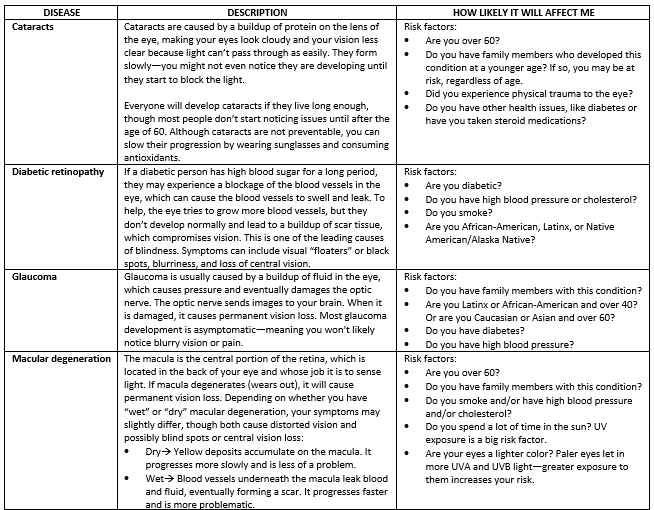
With a fully open pupil, she can see the back of your eye to check for cataracts, glaucoma, macular degeneration, diabetes complications, high blood pressure, and overall eye health concerns (see descriptions below).
Although you are not required to have your eyes dilated during an exam, the doctor strongly recommends doing so, to help her most effectively evaluate and monitor any changes in your eyes over time. It is especially important for her to check your eyes in more depth if you have a family history of the conditions mentioned above.
WHAT ARE THE MOST COMMON EYE DISEASES? HOW LIKELY IS IT THAT THEY COULD AFFECT ME?
The most common eye diseases the doctor is looking for when she checks your eyes include:
If you are concerned about any of these risk factors, talk to the doctor during your eye exam. Also, for more information visit the weblinks below:
DO I NEED A SPECIAL DIABETIC EYE EXAM? WHY?
Diabetes is a disease that affects how your body processes sugar. People with diabetes are more at risk for: 1) retinal detachment, which causes blindness, 2) cataracts—they start earlier and get worse faster, 3) glaucoma. Having a regular (at least once per year) diabetic eye exam may prevent any of these diseases from getting worse, because the doctor is closely following the health of your eyes to make sure your diabetes isn’t damaging your vision. And, the earlier she can catch disease progression, the better it is for your long-term use of your eyes.